

Bubble‑Wrap ‘Snail’ Seed Rolls + Snail‑Proof Planters (UK Guide)
Bubble‑wrap “snail” seed rolls are a low‑cost, space‑saving way to germinate seeds on a windowsill or in a greenhouse. In this guide, you’ll learn which crops love the method, how to build a self‑watering roll, and simple ways to keep actual snails out of your planters — all with UK‑season timing.
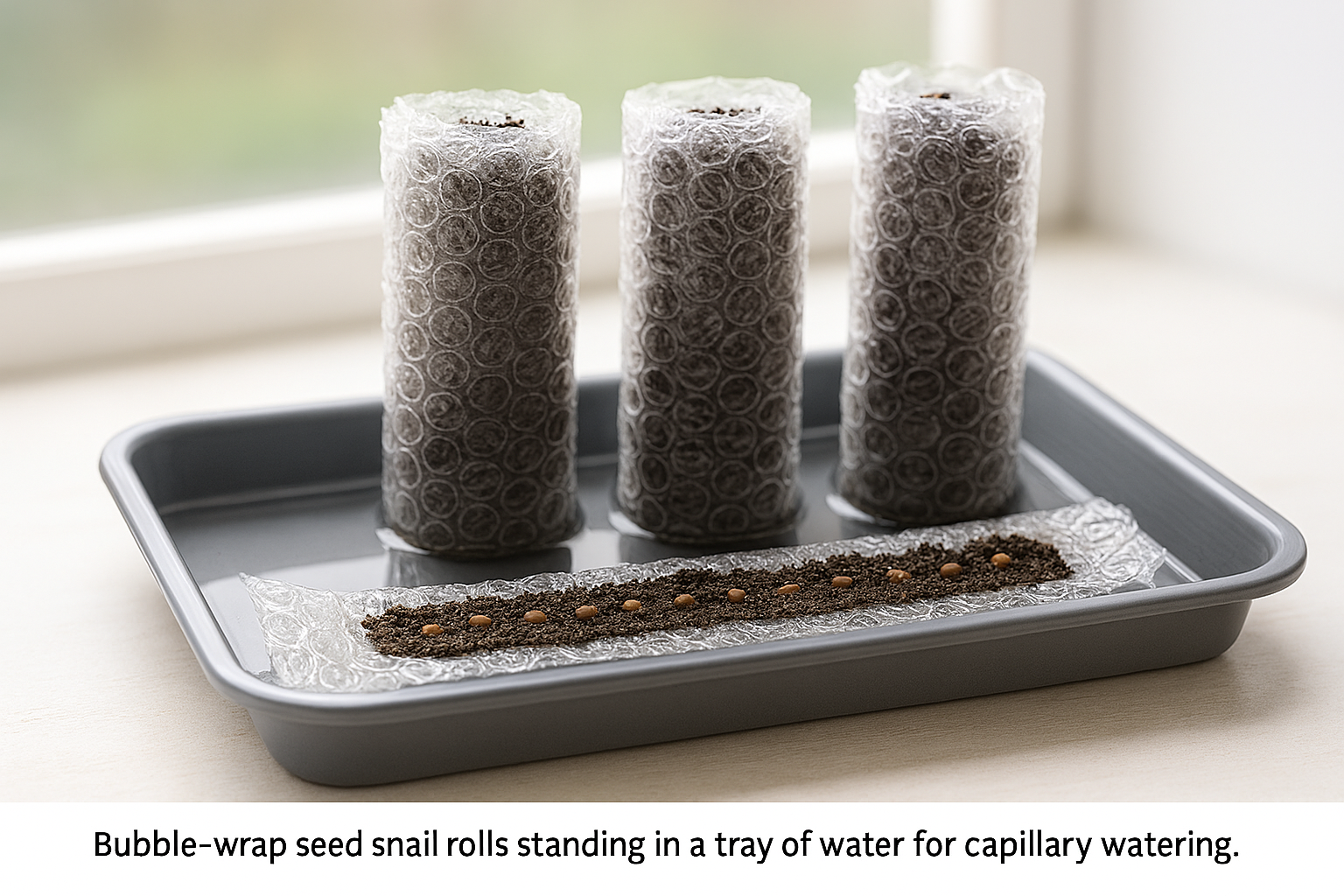
Why the bubble‑wrap “snail” works
- Warmth & moisture stability: trapped air + cover reduces evaporation and evens out temperature swings.
- Capillary watering: a tissue/paper strip draws water from a tray into the roll, keeping seeds evenly moist without drenching.
- Tiny‑space friendly: store multiple rolls upright in a small tray.
This article continues your bubble‑wrap “snail” sowing content and presentation style used in recent reels and YouTube planning notes.
What you’ll need (UK‑ready kit)
- Bubble wrap strip (bubbles facing up)
- Seed compost (sieved)
- Kitchen tissue (for the capillary strip)
- Seeds (see crop list below)
- Tray with 1–2 cm water; elastic bands or clips
- Labels + pencil; clear cover (propagator lid or bag)
Step‑by‑step: build the seed “snail”
- Prep the strip — Lay bubble wrap on the bench, bubbles up.
- Add compost — 0.5–1 cm even layer; mist to damp.
- Sow — Place seeds in a staggered line ~1–2 cm from the top edge.
- Light cover — Dust of compost or vermiculite.
- Capillary base — Lay a tissue strip under the wrap so it peeks from the bottom edge.
- Roll — Roll firmly but not tight; secure with band.
- Water from below — Stand the roll upright in a tray so the tissue dips into the water.
- Position — Bright, frost‑free (windowsill, heated greenhouse). Remove cover once most seeds germinate.
Crops that love the method (start here)
- Chillies, peppers, aubergines — early warmth lovers; sow Jan–Mar under cover.
- Cucumbers & courgettes — late winter/early spring; keep snug and pot‑on promptly.
- Tomatoes — Feb–Mar; transplant as soon as first true leaves appear.
- Leafy greens (lettuce, spinach, kale) — cool‑tolerant; great for winter trials with patience.
- Spring onions, beetroot — steady moisture gives reliable germination.
Snail‑proof your planters (so the other snails don’t win)
- Barriers: copper tape around pot rims; 2–3 cm dry grit ring on the surface.
- Placement: lift pots on feet/bricks to reduce damp “highways”.
- Habitat tweaks: keep foliage off the compost surface; water early so surfaces dry by evening.
- Organic controls: wildlife‑friendly ferric phosphate pellets as a last resort; beer traps away from beds.
- Bubble‑wrap use outdoors: wrap pots, not stems — insulate containers in cold snaps without smothering plants (air gaps matter).
Troubleshooting (quick fixes)
- Mould on compost/tissue → Increase air: loosen the roll, vent the lid, water a touch less.
- Leggy seedlings → More light; move to south‑facing window or add grow‑light; pot‑on sooner.
- Uneven germination → Re‑roll flatter; check the tissue strip is wicking; rotate roll daily.
- Damping‑off → Sterile media, thinner sowing, bottom‑water only, remove cover the moment most seeds pop.
- Roots tangling in tissue → Pot‑on at first true leaf stage; peel tissue gently, don’t yank.
Pot‑on & next steps (when to upgrade)
- At first true leaves, unroll carefully, lift seedlings with a label or dibber, and pot individually into 7–9 cm pots.
- Harden off gradually before planting out; keep a backup roll as insurance in cold spells.
FAQs
Can I re‑use the bubble wrap?
Yes. Rinse with mild soapy water, air‑dry, and store flat. Replace if brittle or cloudy.
Do the rolls replace a heated propagator?
Not exactly; they stabilise warmth and moisture. For heat‑loving crops in January, a heat mat speeds things up.
How wet should the tray be?
Keep 1–2 cm of water; the tissue should be damp, not dripping. Top up little and often.
When do I remove the wrap/lid?
As soon as most seeds germinate; vent early to prevent damping‑off.
What’s the best compost?
Fine, peat‑free seed compost. Sieve if lumpy; avoid rich multipurpose mixes at the sowing stage.
Call‑to‑Action
Ready to try the snail method? Explore our seed and plug plant ranges and set up a windowsill propagation station today. Share your results with @TheMadPlantMan and tag #GrowAndGarden365 for a feature.


.png)
.png)
.png)


